When a Sunken Ship Took Its Own Company to Court and Won
The Ship That Wouldn't Stay Quiet
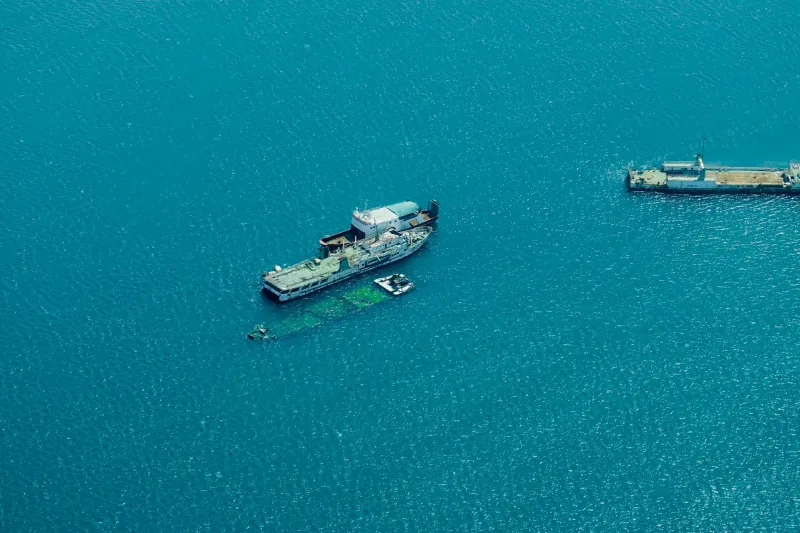
In 1952, the SS Prosperity was deliberately scuttled by its own shipping company in the middle of the Atlantic Ocean. The plan was simple: collect the insurance money, write off the loss, and move on to newer vessels. What the company didn't expect was that seven years later, the sunken ship would drag them into federal court as the plaintiff in one of maritime law's strangest cases.
 Photo: Atlantic Ocean, via bike-station.dk
 Photo: SS Prosperity, via maproom.net
The Prosperity had been a reliable cargo hauler for Meridian Shipping Lines, carrying everything from grain to manufactured goods along the Eastern seaboard. But by the early 1950s, the 30-year-old vessel was becoming expensive to maintain. When a routine inspection revealed the need for costly engine repairs, company executives made a calculated decision: it would be cheaper to sink the ship and collect the insurance than to fix it.
"It was standard practice back then," explained maritime historian Dr. Elena Vasquez. "Shipping companies regularly scuttled aging vessels rather than paying for major repairs. The insurance industry expected it, and maritime law accommodated it - as long as proper procedures were followed."
But Meridian Shipping had cut one corner too many.
The Forgotten Partner
What the company had overlooked was that they didn't own the Prosperity outright. Buried in decades-old paperwork was a 15% ownership stake held by Thomas Brennan, a former company executive who had taken partial ownership in lieu of unpaid wages during the Depression.
 Photo: Thomas Brennan, via static.vecteezy.com
Brennan had long since moved to California and started a successful restaurant business. He'd forgotten about his small stake in the aging cargo ship until he received a newspaper clipping from his nephew about the Prosperity's sinking. When Brennan contacted Meridian Shipping to ask about his share of the insurance payout, company lawyers informed him that minority shareholders weren't entitled to compensation for "necessary business decisions."
That's when Brennan discovered something remarkable: under maritime law, his 15% ownership meant he had partial ownership of the wreck itself, not just the company's decision to sink it.
Ancient Laws, Modern Problems
Brennan's lawyer, a young San Francisco attorney named Robert Kellerman, found the legal foundation for their case in the Merchant Marine Act of 1920. The law, designed to protect American shipping interests, contained provisions that treated vessels as separate legal entities capable of owning property and, in certain circumstances, bringing legal action.
"The ship itself could be considered a party in admiralty court," Kellerman explained in court documents. "Since Mr. Brennan retained partial ownership of the vessel, and the vessel was deliberately destroyed without his consent, the wreck has standing to sue for damages."
Federal Judge Harrison Whitmore initially dismissed the case as "creative but frivolous." But Kellerman appealed, citing precedents dating back to colonial maritime law where ships had been treated as legal entities in salvage and prize cases.
The appeals court was intrigued enough to allow the case to proceed, ruling that "while unusual, the plaintiff's interpretation of maritime law appears to have historical precedent worth examining."
The Wreck Takes the Stand
The trial that followed in 1959 was unlike anything in maritime legal history. Court records officially listed the plaintiff as "SS Prosperity (Wreck), by Thomas Brennan, Minority Owner." Meridian Shipping found itself in the bizarre position of being sued by a ship they had deliberately sunk.
The case hinged on a fundamental question: could a shipping company unilaterally decide to destroy a vessel when minority shareholders hadn't consented to the action? Meridian's lawyers argued that business decisions were the prerogative of majority ownership. Brennan's team countered that the ship itself - as a legal entity under maritime law - had been murdered without due process.
"It sounds absurd now," noted legal scholar Professor David Chen, "but maritime law has always treated ships differently from other forms of property. Vessels can be arrested, held in custody, and even put on trial. The idea of a ship suing its owners wasn't as far-fetched as it seemed."
The testimony revealed that Meridian had never attempted to contact Brennan before scuttling the Prosperity. Company executives had simply assumed his small stake was irrelevant to their decision-making process.
Victory From the Deep
In a ruling that shocked the maritime industry, Judge Whitmore found in favor of the SS Prosperity. The court determined that Meridian Shipping had illegally destroyed property belonging to a minority shareholder without proper notification or compensation.
"The defendants treated the vessel as their exclusive property when it was, in fact, partially owned by the plaintiff," the judge wrote. "Under admiralty law, the wreck retains its legal status as the damaged remains of the original vessel, and therefore maintains standing to seek redress for its wrongful destruction."
Meridian Shipping was ordered to pay Brennan $47,000 - his proportional share of the ship's insured value plus damages for lost potential income. The company was also required to pay court costs and attorney fees.
More importantly, the ruling established a precedent that would influence maritime law for decades. Insurance companies began requiring unanimous consent from all shareholders before approving scuttling claims. Shipping companies started conducting more thorough ownership audits before making decisions about aging vessels.
Ripples Across the Industry
The SS Prosperity case quietly revolutionized how maritime insurance fraud was prosecuted. Federal investigators began looking more closely at deliberate sinkings, knowing that any overlooked minority ownership could result in successful legal challenges.
"The case made scuttling much more expensive and complicated," explained maritime insurance expert Patricia Donnelly. "Companies couldn't just sink ships and collect insurance anymore. They had to prove they had complete legal authority to destroy the vessel."
Brennan used his settlement money to expand his restaurant business, eventually opening three successful establishments in California. He never owned another ship, but he kept the court judgment framed in his office as a reminder that sometimes the little guy wins - even when the little guy is a sunken cargo vessel.
The SS Prosperity remains on the ocean floor somewhere in the North Atlantic, but its legal victory lives on in maritime law textbooks. It's still the only case on record where a shipwreck successfully sued the company that sank it, proving that sometimes justice comes from the most unexpected depths.