How One Army Translator Accidentally Ended a War — And Both Sides Played Along
There's a version of diplomacy that happens in marble halls, between men in suits, with cameras rolling and pens poised over documents that will be framed and hung in libraries. And then there's the version that actually keeps people alive — the kind that happens in tents, through exhausted interpreters, across folding tables, in languages nobody in the room fully trusts.
The Korean War ceasefire negotiations were the second kind. They dragged on for over two years, grinding through procedural standoffs and propaganda battles while men kept dying on a front line that barely moved. And somewhere inside that slow-motion diplomatic machinery, a single low-ranking translator apparently said something he had no authority to say — and accidentally made it stick for nearly half a year.
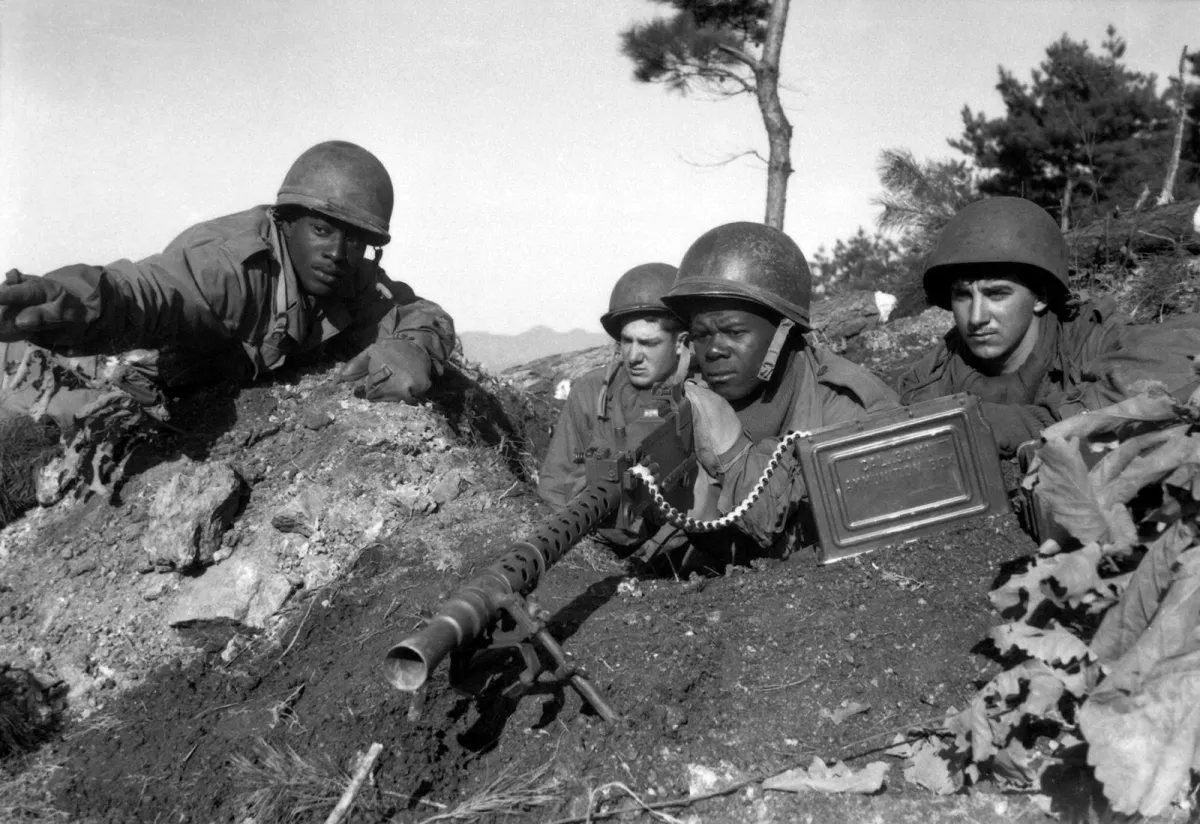 Photo: Korean War, via cdn.britannica.com
The Room Where Nobody Was Really in Charge
By the early 1950s, the talks at Panmunjom had developed their own bizarre culture. Delegations would sometimes sit in complete silence for hours. Interpreters worked under enormous pressure, translating not just words but intent — and occasionally, filling gaps that neither side wanted to acknowledge out loud.
The specific incident, pieced together from declassified liaison memos and postwar debriefs, centers on a session in which preliminary discussions about a localized buffer arrangement were underway. The talks concerned a specific stretch of contested territory where skirmishes had been flaring up and disrupting the broader negotiation schedule. Both sides wanted the noise to stop, but neither wanted to be seen as making a formal concession.
Enter the translator — a young Army corporal attached to the U.S. delegation, whose name appears in records only in partial form. During a recess, in an informal exchange with a North Korean liaison officer, he apparently characterized a proposed American position in terms that went further than his superiors had authorized. The phrasing, as best as historians have reconstructed it, implied a mutual stand-down along that sector — not a suggestion, but a statement of agreed fact.
The Silence That Followed
Here's where the story gets genuinely strange. The North Korean liaison officer didn't push back. He nodded, relayed the exchange to his own delegation, and within days, the shooting in that sector stopped.
Back on the American side, officers noticed the quiet and assumed their counterparts had simply decided to de-escalate. Nobody went looking for a paper trail because everyone assumed someone else had signed off on it. The corporal, apparently understanding exactly what he'd done, said nothing.
For months, the informal arrangement held. Field commanders on both sides operated under the assumption that the stand-down was legitimate. Supply routes shifted. Troop rotations adjusted. The silence became its own kind of infrastructure.
When the Machinery Noticed
The arrangement began to unravel not through any dramatic confrontation but through the most mundane of bureaucratic processes: a routine documentation review. A senior U.S. liaison officer, preparing a summary of all active informal agreements for a higher-level briefing, couldn't find the paperwork authorizing the sector stand-down. He flagged it. People started asking questions.
What followed, according to the memos, was a quiet institutional panic. The arrangement had no legal standing. It had never been approved by anyone with actual authority. And yet both sides had been honoring it for the better part of six months — and the front had been measurably quieter for it.
The decision made by American commanders was, in its own way, just as remarkable as the original mistake: they let it ride. Quietly formalizing the arrangement through back channels, they essentially ratified what a nervous corporal had invented in a tent. The North Korean side, for their part, showed no interest in exposing the fiction either. An unofficial peace, it turned out, was still a peace.
What It Says About the Machinery of War
The story has never become a household name, and that's partly the point. It doesn't fit the narrative we prefer for diplomacy — the one where great decisions are made by great men in great rooms. It fits a different narrative, one that's harder to celebrate: that the machinery of war and peace is operated by human beings who make mistakes, cover for each other, and sometimes stumble into outcomes that careful planning never could have engineered.
Ceasefire negotiations are supposed to be the most controlled environments in conflict — every word measured, every gesture deliberate. And yet here was a corporal, probably sleep-deprived, probably terrified, who said the wrong thing at the right moment and bought six months of quiet for a stretch of ground that had been soaked in blood.
The Korean War armistice was eventually signed in July 1953. The sector in question was folded into the broader agreement. The corporal was quietly reassigned.
History doesn't record whether he ever told anyone what he'd done. But somewhere in a box of declassified liaison memos, the paper trail survives — a reminder that the line between catastrophe and peace is sometimes thinner than a translator's nerve.
And sometimes, the most important diplomatic achievement of a conflict is the one nobody was supposed to make.