Population: One. Mayor: Also One. Taxpayer: You Guessed It. The Farmer Who Accidentally Founded a Town.
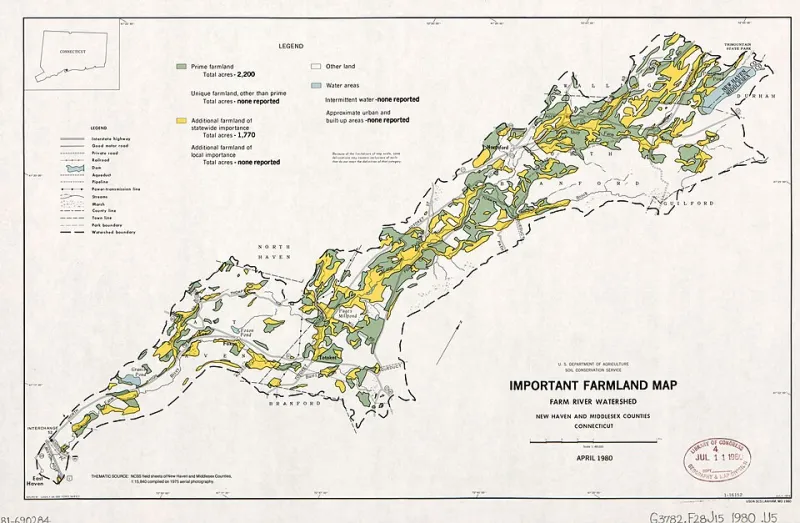
Photo: United States. Soil Conservation Service, Public domain, via Wikimedia Commons
At some point in the mid-twentieth century, a data entry clerk somewhere in a state census office made a small mistake. It probably took less than ten seconds. A property boundary was entered slightly wrong, a rural coordinate got tagged with an incorporation flag it had no business having, and a stretch of farmland that had never asked to be anything other than farmland was quietly, officially, and entirely accidentally designated as an incorporated municipality.
The farmer who owned the land didn't find out until the paperwork started arriving.
How the Census Builds Reality
Most people think of the U.S. Census as a counting exercise. It is. But it's also something more than that — it's a document-generation machine, and the documents it generates carry legal weight that can ripple outward for years.
State and county agencies routinely use census data as a primary input for administrative decisions. Zoning offices, water districts, tax authorities, and business licensing boards all reference census designations when determining what obligations apply to a given piece of land or a given address. When the census says a place is a municipality, those agencies take that at face value. It's not their job to audit the census. It's their job to act on it.
So when the error in question — a misapplied incorporation flag attached to a rural property coordinate — made its way into the official census record, it didn't just sit there as an inert data point. It propagated. Agencies downstream picked it up, cross-referenced it against their own records, and began treating the designated area as what the census said it was: an incorporated municipality with a recorded population of exactly one.
A Town With Extremely Manageable City Council Meetings
The farmer, by most accounts a practical man with no particular interest in municipal governance, received his first piece of official correspondence addressed to the new "municipality" without fully understanding what he was looking at. It was a business license notification — a form letter informing the relevant parties within the designated area that certain commercial activity thresholds would require licensing under state business regulations.
He filed it in a drawer and mostly forgot about it.
The water district assessment arrived a few months later. This one was harder to ignore, because it included a dollar figure and a due date. The assessment was calculated on the basis of the municipality's designation and its single-resident population count — which, while resulting in a fairly modest fee, was real money attached to a real deadline.
The farmer called the water district. The water district checked their records, confirmed the municipality designation, confirmed the population count, and politely explained that the assessment was valid and payable.
He paid it.
The Feedback Loop Nobody Designed
What makes this story particularly strange is what happened next — which is to say, not very much, for quite a long time.
The farmer, faced with the choice between paying relatively small fees and navigating the bureaucratic process of challenging a census designation (a process that, in the mid-twentieth century, involved multiple state agencies, formal petition procedures, and timelines measured in years), chose to pay. It was easier. It was cheaper, at least in terms of time and aggravation. And there was, perhaps, some part of him that assumed someone would eventually notice and correct the error without his involvement.
That assumption turned out to be optimistic.
Because he paid the assessments, the agencies issuing them had no reason to question the underlying designation. Payment confirmed, in their records, that the municipality was functional and its sole resident was compliant. The data point reinforced itself. Every year the fees were paid, the ghost municipality became a little more real in the administrative sense — not because anything had changed on the ground, but because the paperwork said it was real and someone kept responding to the paperwork.
This is the feedback loop that makes the story genuinely interesting. The census created the municipality. The agencies acted on the census. The farmer responded to the agencies. The agencies recorded the response as confirmation. The municipality persisted.
Untangling It
The resolution, when it finally came, arrived through a combination of a county records audit and a local newspaper reporter who had a gift for finding the strangest item in any stack of public documents.
The story of the one-person municipality ran as a human-interest piece in a regional paper and attracted enough attention that a state legislator took notice. A formal review of the census record identified the original data entry error, and the incorporation flag was removed from the property's designation. The water district and the business licensing board were notified. The municipality was un-created.
The farmer, who had by this point been the sole citizen, de facto mayor, entire city council, and only taxpayer of his accidental town for the better part of a decade, reportedly expressed relief and some mild frustration. He did not, as far as anyone recorded, request a refund for the years of assessments he'd paid into a government structure that existed only because a clerk had hit the wrong key.
The Stranger Truth About Data and Obligation
It would be easy to frame this as a story about government incompetence, and there's certainly an element of that. But the more interesting angle is what it reveals about the relationship between data and legal obligation in a modern administrative state.
The farmer didn't found a town. He didn't apply for incorporation. He didn't file any paperwork, attend any meetings, or make any decisions. He simply owned land that a data entry error designated incorrectly, and from that single mistake, a chain of bureaucratic consequences unfolded that took years to stop.
The census didn't just count his town. In a very real sense, it created it.
And for a while, he was all of it.