Voters Kept Sending a Dead Man to Washington — and Washington Kept Letting It Happen
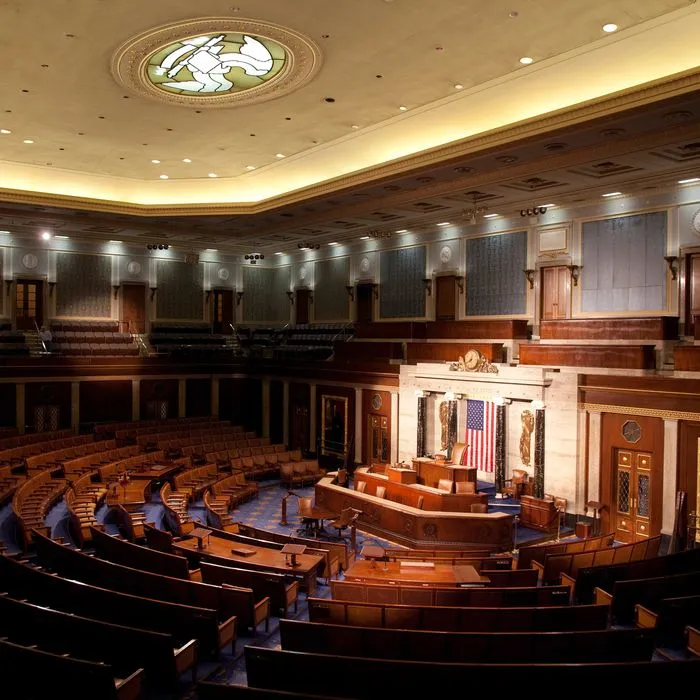
Photo: empty congressional chamber Capitol building seats, via pyxis.nymag.com
Somewhere in the fine print of American democracy, there is apparently no rule against electing a corpse to Congress. You'd think that would come up. You'd think someone, at some point in the drafting of election law, would have said, "Hey, let's add something about the candidate needing to be alive." Nobody did. And the consequences have been genuinely bizarre.
This isn't a story about one isolated fluke. It's a story about a loophole so wide that multiple states have driven a hearse through it — sometimes repeatedly.
The Mechanics of Electing a Ghost
To understand how this keeps happening, you need to understand how election timelines work. In most states, ballots are printed weeks before Election Day. Candidates are certified, names are locked in, and the presses run. If a candidate dies after that certification deadline — which in many states is 30 to 60 days before the election — their name stays on the ballot regardless.
Voters show up, see the name, and vote for it. Sometimes they know the candidate is dead. Sometimes they don't. And in cases where the deceased candidate had deep community ties and a well-organized political machine behind them, the votes roll in anyway.
When that happens, what comes next depends entirely on the state. Some hold special elections. Some allow the party to appoint a replacement. Some do both. The dead candidate can, technically, win — and in several documented cases, they have.
Missouri, 2000: The Senate Race That Rewrote the Rulebook
The most famous example in modern American political history unfolded in Missouri in the fall of 2000. Governor Mel Carnahan was running for U.S. Senate against incumbent John Ashcroft when, just three weeks before Election Day, Carnahan was killed in a plane crash.
His name stayed on the ballot. Missouri's deadline had long passed.
On November 7, 2000 — the same night the country was losing its mind over the presidential race in Florida — Missouri voters elected Mel Carnahan to the United States Senate. He had been dead for 22 days.
Carnahan won by about 49,000 votes. Ashcroft, who would go on to become U.S. Attorney General under George W. Bush, lost his Senate seat to a man who could not physically show up to claim it.
Missouri's incoming governor, Roger Wilson, appointed Carnahan's widow, Jean, to fill the seat. She served until 2002. The dead man had, in a very real sense, won.
This Was Not a New Phenomenon
Carnahan's case made national headlines, but the underlying pattern stretches back much further. American political history has a recurring subplot where deceased candidates outperform expectations, and in some instances, outperform their living opponents.
In the 19th and early 20th centuries, before media saturation made candidate deaths instantly national news, voters in rural districts sometimes cast ballots without knowing their chosen candidate had passed away days earlier. Local party machines, invested in the outcome, had little incentive to advertise the news widely.
The result was a quiet tradition: a candidate dies, the party rallies, the votes come in, and the machinery of government figures out the rest afterward.
What's remarkable isn't just that it happened. It's that it happened often enough that legal scholars have written extensively about the constitutional questions it raises, and that most states still haven't fully closed the gap.
The Loyalty Factor
There's a human element here that pure legal analysis tends to skip over. In many of these cases, voters who knew their candidate had died voted for them anyway — deliberately, defiantly, and in large numbers.
In Carnahan's case, supporters argued that voting for him was a way of honoring his legacy and ensuring his party retained influence. In other cases, voters in tight-knit communities have described their posthumous votes as a form of tribute, a final act of loyalty to someone they believed in.
This is, depending on your perspective, either deeply touching or a fascinating illustration of how political identity can override almost any other consideration — including the basic logistical problem of the person being gone.
What Happens to the Seat?
When a deceased candidate wins, the process that follows varies wildly. Special elections are common but not universal. Party appointments happen in some states, meaning a small group of insiders effectively gets to choose the winner of an election that thousands of people just voted in. In rare cases, the seat has sat temporarily vacant while legal and legislative machinery ground through the question of what to do.
In at least a few historical instances, staff members and party operatives continued carrying out the business of a congressional office for weeks after a representative's death, while the formal transfer of power was sorted out. The office kept running. The work kept moving. The name on the door just didn't match anyone breathing.
The Loophole That Refuses to Close
Legislators at the state and federal level have periodically proposed fixes — earlier deadlines, emergency ballot replacement procedures, clearer succession rules. Some have passed. Many haven't.
Part of the resistance is practical: election administration is complicated, and changing the rules mid-cycle creates its own problems. Part of it is political: neither party has a strong incentive to push for reforms that might one day cost them a seat they'd otherwise inherit.
And part of it, honestly, might just be that American democracy has always had a slightly improvisational quality. The founders built a system with a lot of room for edge cases, and the edge cases have been delivering surprises ever since.
The dead keep running. The voters keep deciding. And somewhere in a law library, a very tired election attorney is updating their notes.