They Built Their Town. They Flooded Their Town. Then They Built Their Town Again — On Top of It.
There's a particular kind of American stubbornness that expresses itself through repetition. You knock something down, we build it back. You flood it, we find higher ground and start over. It's practically a national tradition.
But the residents of one small valley community in the mid-20th century took that tradition somewhere nobody had quite anticipated. When their town was deliberately flooded to create a federal reservoir, they relocated, rebuilt, and resumed their lives on a patch of ground that felt familiar for reasons they couldn't quite explain. It wasn't until a brutal drought decades later — when the water level dropped far enough to expose the valley floor — that they understood why.
They had rebuilt their town on top of their old town. Not near it. Not beside it. On it.
A Valley Worth Flooding
The story begins, as so many strange American stories do, with a federal infrastructure project and a community that didn't have much say in the matter.
The valley in question — a long, narrow stretch of agricultural land threaded through by a river — had been identified by Army Corps of Engineers planners as an ideal location for a flood control reservoir. The geography was right. The hydrology was right. The politics, eventually, were right. What wasn't right was the several hundred families who had been farming and living there for generations.
They were bought out, compensated according to the government's assessment of their property values, and told to find somewhere else to be. Most of them didn't go far. The surrounding area was familiar, the soil was similar, and the social infrastructure — the churches, the school connections, the extended families — pulled people toward a particular ridge of land that sat just above the planned waterline.
The relocation was managed well enough that it became something of a case study in how to move a community without completely destroying it. People rebuilt. The dam went up. The valley filled. Life continued.
The Ground Felt Right
What nobody fully registered at the time — and what would only become obvious much later — was how the topography of the ridge related to the topography of the flooded valley below.
The ridge wasn't a random piece of high ground. It was the natural extension of the same geological formation that had shaped the original valley. The drainage patterns were similar. The way the land sloped, the way creeks cut through it, the natural clearings where flat ground appeared — all of it echoed the original settlement in ways that felt intuitive to people who had spent their lives reading that landscape.
So when residents chose lots and platted streets and decided where to put the new town center, they were, without realizing it, following the same logic their grandparents had used when they'd settled the original valley. The new main street ran roughly parallel to the old one. The new church sat on a rise that mirrored the rise where the old church had stood. The residential blocks arranged themselves in patterns that rhymed with the arrangements now sitting under fifty feet of water.
It wasn't identical. But it was close enough to be eerie once someone finally noticed.
When the Water Left
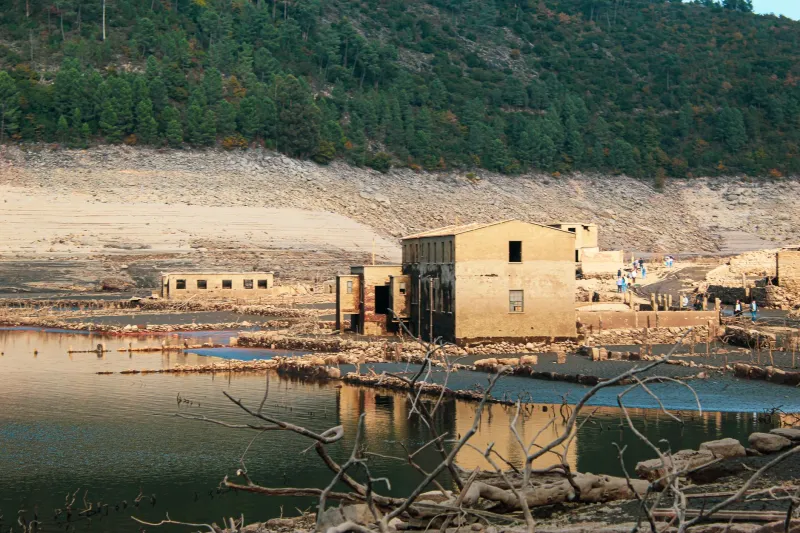
The drought hit hard. In dry years, reservoirs drop. In bad drought years, they drop dramatically — and this one dropped far enough that the original valley floor began to reappear for the first time in decades.
Local people drove out to look, the way people always do when something long-submerged comes back into the light. What they found stopped more than a few of them cold.
The old foundations were still there. The stone walls of the original buildings, the concrete pads, the remnants of the original road surface — preserved under the sediment, exposed now by the retreating water. And residents standing on the reservoir's newly exposed mudflats began to recognize, in the ruins beneath their feet, something uncomfortably familiar.
The street grid below matched the street grid above. Not perfectly — decades of individual decisions had introduced variations — but the correspondence was unmistakable once you were looking for it. The new hardware store sat almost directly above the footprint of the old hardware store. The new elementary school's property line ran within yards of where the original school's property line had been recorded in county documents.
Geologists and surveyors who came in afterward confirmed what the eyeball comparison suggested. The community had, through a combination of shared spatial instinct and identical underlying terrain, rebuilt itself in almost the same location it had been removed from.
Living on Your Own Ghost
The implications took a while to settle in.
Some residents found the whole thing wonderful — a testament to community memory, to the way a place can persist in people's habits and instincts even after the physical place is gone. Others found it genuinely unsettling. They had been living, without knowing it, on top of their own history. Their backyards sat above their grandparents' backyards. Their foundations were anchored in the same earth their old foundations had been pulled from.
There were practical concerns too. The original town's infrastructure — old pipes, buried tanks, the occasional forgotten well — was now directly beneath the new town's infrastructure. Engineers had to go back and audit what was down there before anyone could be sure the ground was stable.
But the strangest part of the whole episode wasn't the engineering. It was the reminder that people, given a familiar landscape and a familiar set of needs, will make remarkably similar decisions — even when they don't know they're repeating themselves.
The valley remembered what it was for. And apparently, so did the people who lived in it.