The Cursed Cargo Ship That Made Insurance Companies Rich While Defying Every Law of the Sea
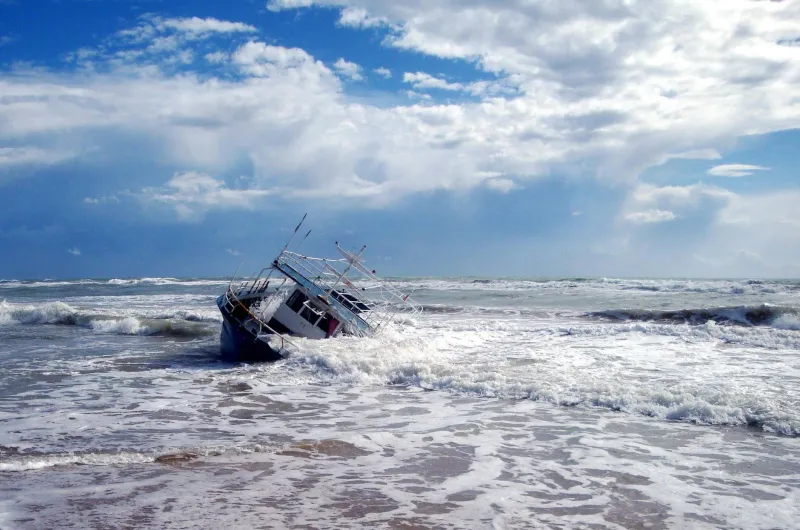
When Bad Luck Becomes Big Business
In the annals of American maritime history, no vessel has confounded insurance adjusters quite like the SS Wanderer. Between 1847 and 1862, this seemingly ordinary cargo ship managed to sink four separate times, each incident occurring under different owners, in different waters, and under completely different circumstances. Yet every single time, insurance companies dutifully paid out claims — because somehow, impossibly, each disaster was entirely legitimate.
The story sounds like the plot of a maritime con game, the kind of elaborate fraud that would make even the most creative swindler proud. But here's where reality becomes stranger than fiction: despite multiple investigations spanning fifteen years, no evidence of deliberate sabotage or insurance fraud was ever uncovered. The Wanderer wasn't a victim of criminal conspiracy — it was just the unluckiest ship in American waters.
The First Dance with Davy Jones
The Wanderer's troubled relationship with the ocean began in October 1847, just two years after her maiden voyage. Built in Baltimore as a sturdy cargo vessel designed for coastal trade, she seemed destined for a long, profitable career hauling goods between Southern ports. Instead, she found herself at the bottom of Charleston Harbor after a collision with another vessel during a sudden fog bank.
The sinking was thoroughly investigated by both maritime authorities and insurance adjusters. Weather records confirmed the unexpected fog. Harbor records showed the other vessel's legitimate presence. Witness testimony aligned perfectly. The insurance company, Lloyd's of Charleston, paid out the full claim of $18,000 — a substantial sum in 1847 dollars — and wrote off the incident as simple bad luck.
What they couldn't have predicted was that this was just the opening act.
Rising from the Deep — Twice
Here's where the Wanderer's story takes its first turn toward the impossible: she was successfully raised from Charleston Harbor in early 1848. Salvage operations in the mid-19th century were notoriously difficult and expensive, but a consortium of investors saw potential in the relatively new vessel. After months of work, the Wanderer was refloated, repaired, and sold to new owners in Savannah.
For three years, she operated without incident. Then, in September 1851, the Wanderer sank again — this time after running aground during a hurricane off the coast of North Carolina. Once again, investigators found nothing suspicious. The storm was well-documented, the ship's course was logical given the weather conditions, and the crew's actions were entirely reasonable. The new insurance company, Atlantic Maritime Assurance, paid out another substantial claim.
And once again, against all economic logic, investors raised her from the sea floor.
The Pattern Emerges
By 1852, the Wanderer was operating under her third set of owners, and maritime insurance companies were beginning to take notice. Not because they suspected fraud — the investigations had been thorough — but because the ship was becoming a statistical anomaly. Most vessels that sank once, if raised at all, were sold for scrap. The Wanderer kept finding new owners willing to bet on her seaworthiness.
Their confidence proved misplaced in August 1855, when the Wanderer sank for the third time after a boiler explosion in Mobile Bay. This incident triggered the most extensive investigation yet, with insurance adjusters, federal maritime inspectors, and even Pinkerton detectives examining every aspect of the ship's history and the explosion's cause.
Their conclusion? The boiler failure was the result of a manufacturing defect that had gone undetected through multiple inspections. The explosion was not only accidental but probably inevitable given the boiler's construction. Once again, the insurance claim was paid in full.
Once again, the Wanderer was raised and sold to new owners.
The Final Curtain
The Wanderer's fourth and final sinking came in March 1862, during the height of the Civil War. Pressed into service as a blockade runner, she was attempting to slip past Union naval forces when she struck an uncharted reef off the Florida coast. The impact tore open her hull, and she went down in deep water — too deep for salvage operations with the technology of the era.
This time, there would be no resurrection.
The insurance investigation was complicated by wartime conditions, but even Union naval officers confirmed the reef's existence and the ship's legitimate mission. The final payout brought the total insurance claims on the Wanderer to over $75,000 — equivalent to roughly $2.5 million in today's money.
The Mystery That Never Solved Itself
What made the Wanderer's story so baffling wasn't just the repeated sinkings — it was the complete absence of any reasonable explanation beyond extraordinary bad luck. Maritime historians have studied her case for over a century, looking for patterns that might explain her unusual career.
Some theories emerged: perhaps her design had a fundamental flaw that made her unusually vulnerable to certain types of accidents. Maybe her repeated salvage operations had weakened her structure in ways that contemporary inspections couldn't detect. Or possibly, the ship's reputation for sinking actually attracted owners who were hoping for insurance payouts — though no evidence of such intentions was ever found.
The most unsettling possibility is the simplest one: sometimes reality is just stranger than fraud. The Wanderer may have been nothing more than the victim of genuinely impossible bad luck, a vessel that somehow managed to find disaster four separate times without any human intervention.
A Legacy Written in Water
Today, the Wanderer's story lives on in maritime insurance textbooks as a cautionary tale about the unpredictability of risk assessment. Her case helped establish many of the investigative procedures still used by marine insurance adjusters, and her multiple legitimate claims contributed to the development of more sophisticated actuarial tables for vessel insurance.
But perhaps more importantly, the Wanderer stands as a reminder that sometimes the most unbelievable stories are true precisely because they're too strange to have been invented. In a world where truth is often stranger than fiction, the SS Wanderer proved that even the ocean floor couldn't keep a truly unlucky ship down — at least not permanently.